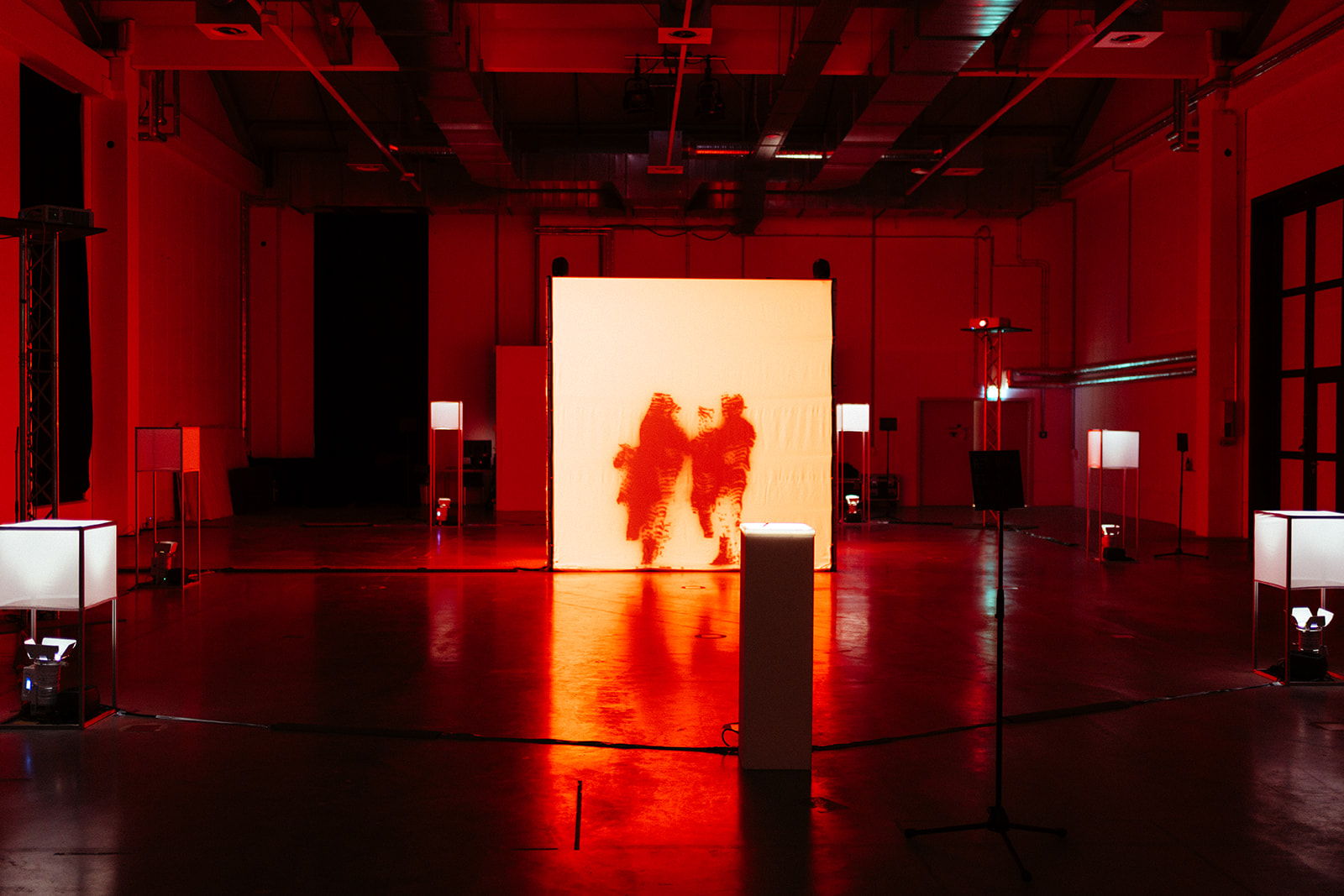
- Format: Interactive audiovisual installation
- Medium: Projections, point-cloud & sound capture, real-time, Light Pillars, spatial sound, computer vision, embodied interaction
- Space: approx. 12 x 15 m minimum footprint and 3.5 m ceiling height for the full installation setup
Overview
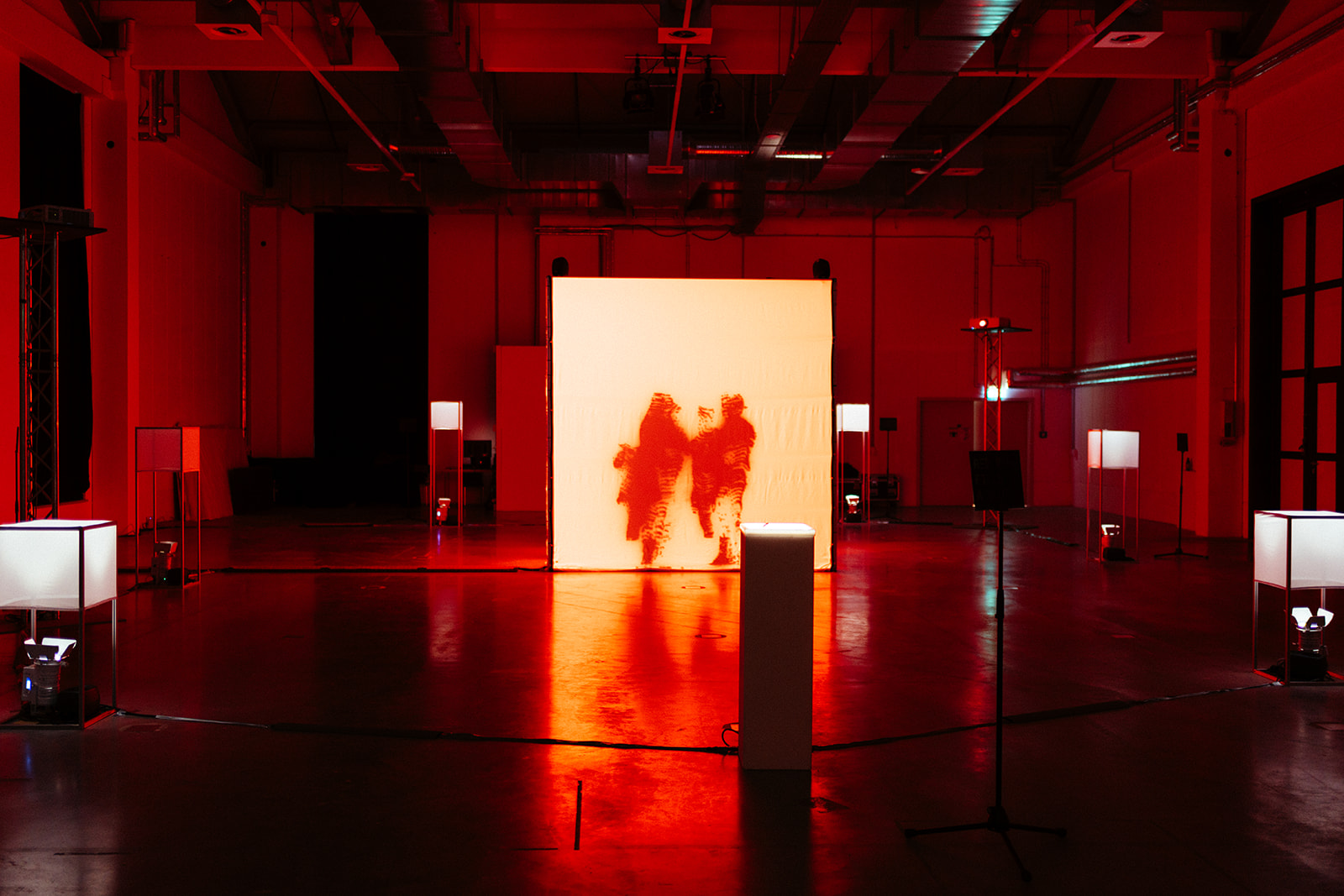
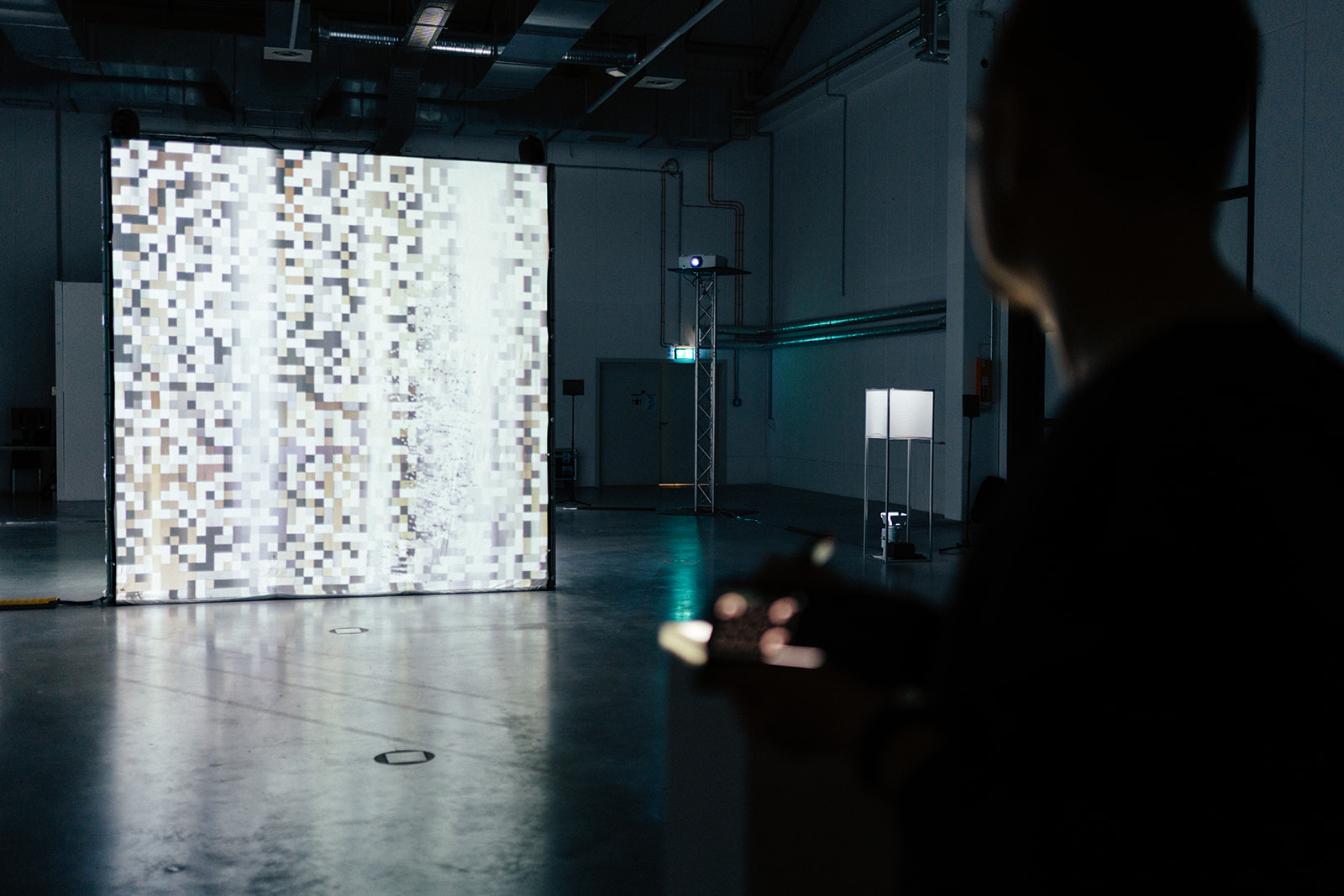
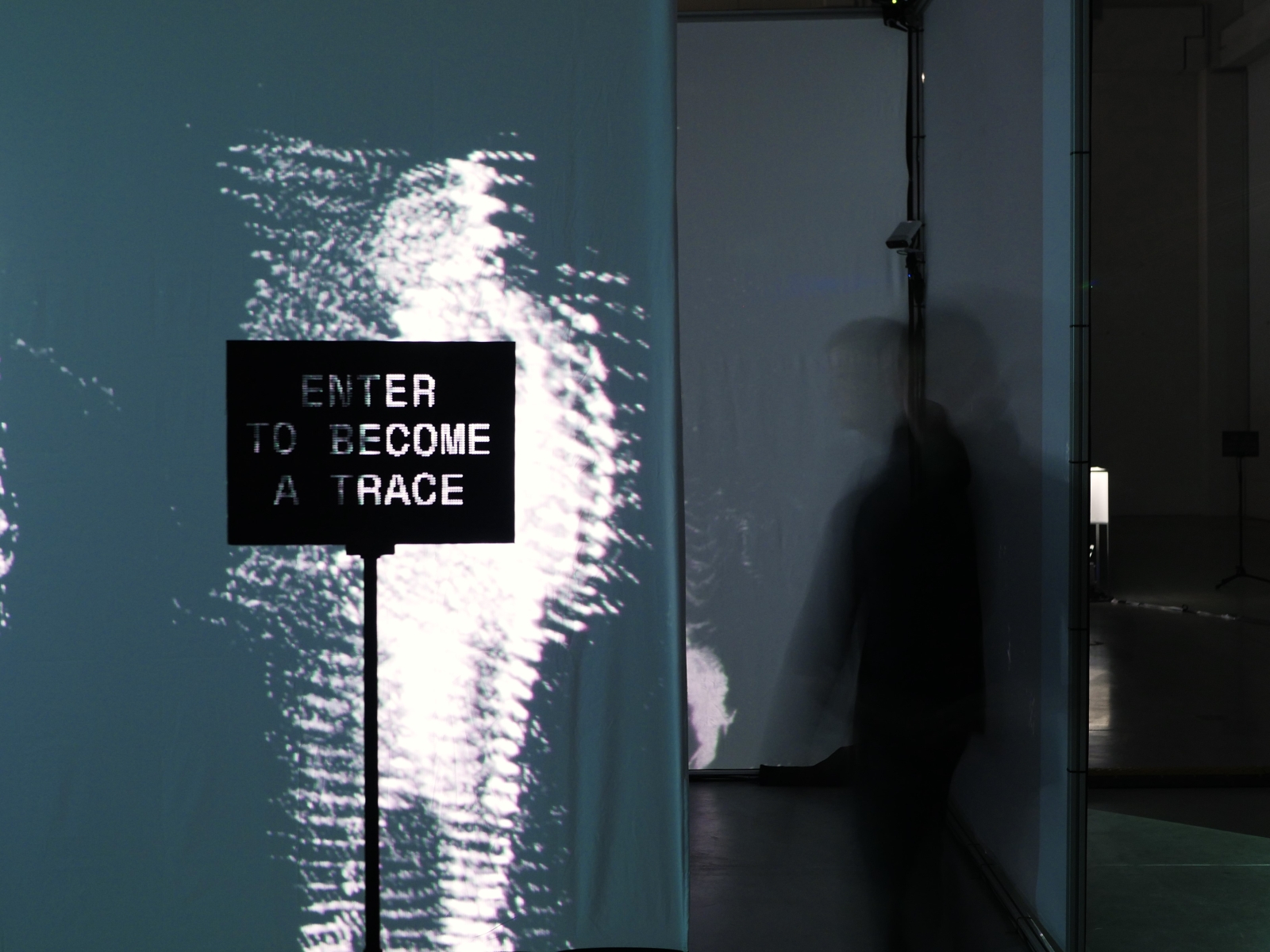
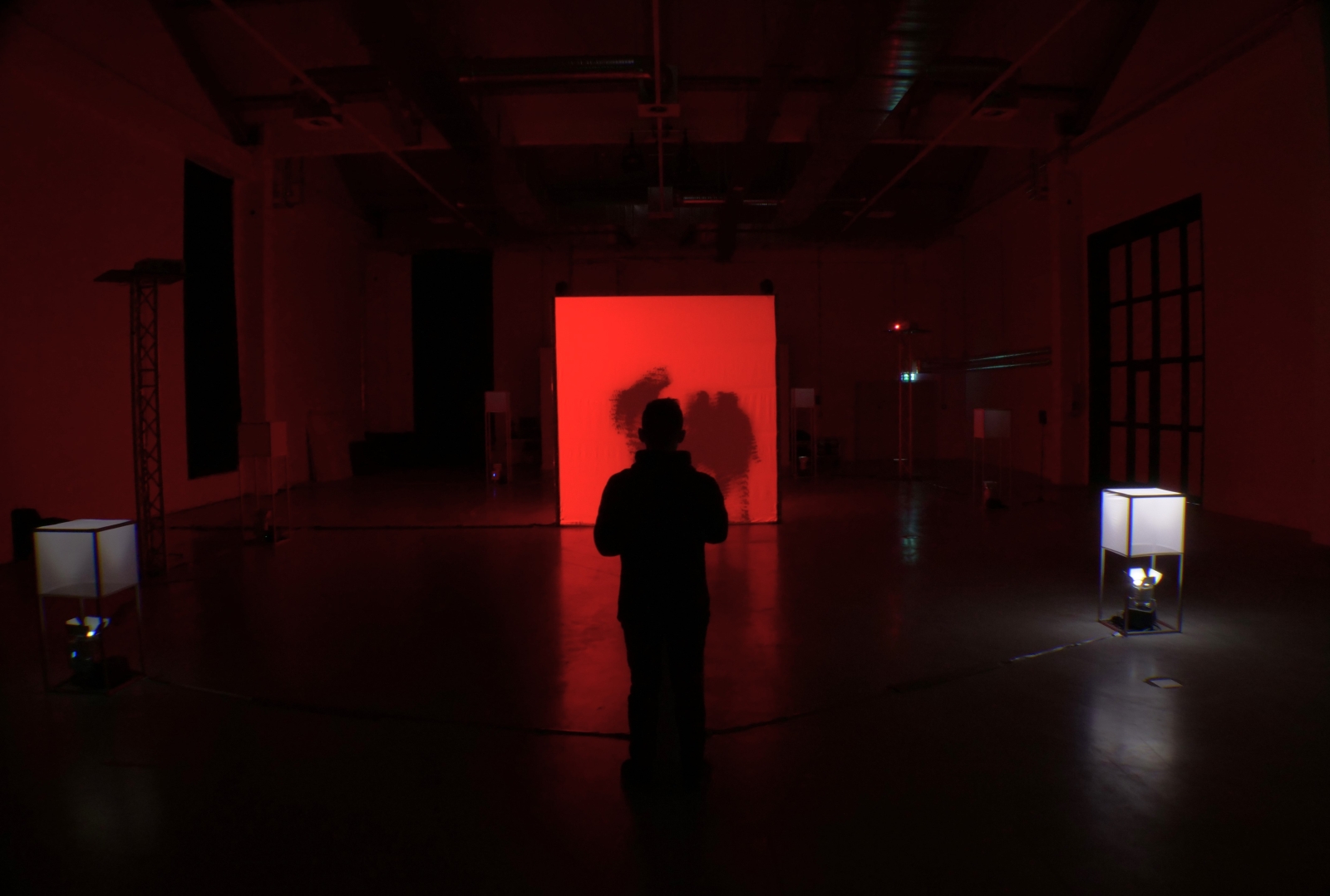
in the digital shadow is an interactive audiovisual installation built as a spatial memory system. Visitors enter a projection chamber, become recorded as point-cloud shadows, and see those traces return through projection surfaces, Light Pillars, and spatial sound.
The installation interprets creative labour through the residue it leaves behind. Files, schedules, budgets, chats, self-tracking marks, delegated work, technical leftovers, fatigue, and recovery form the research material behind the work. In the space, these pressures become a system that collects, stores, allocates, overloads, and partially releases visitor traces.
Spatial System
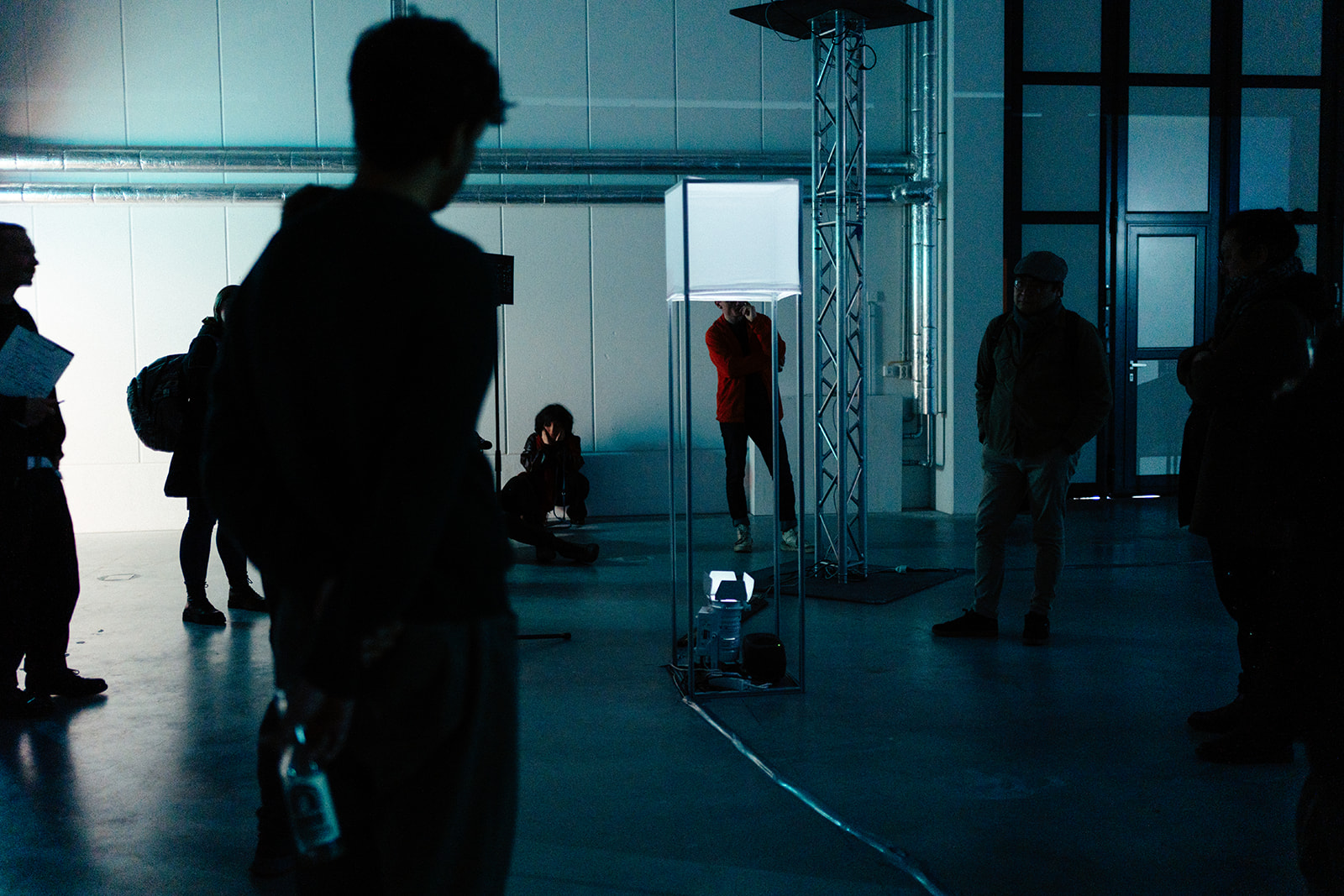
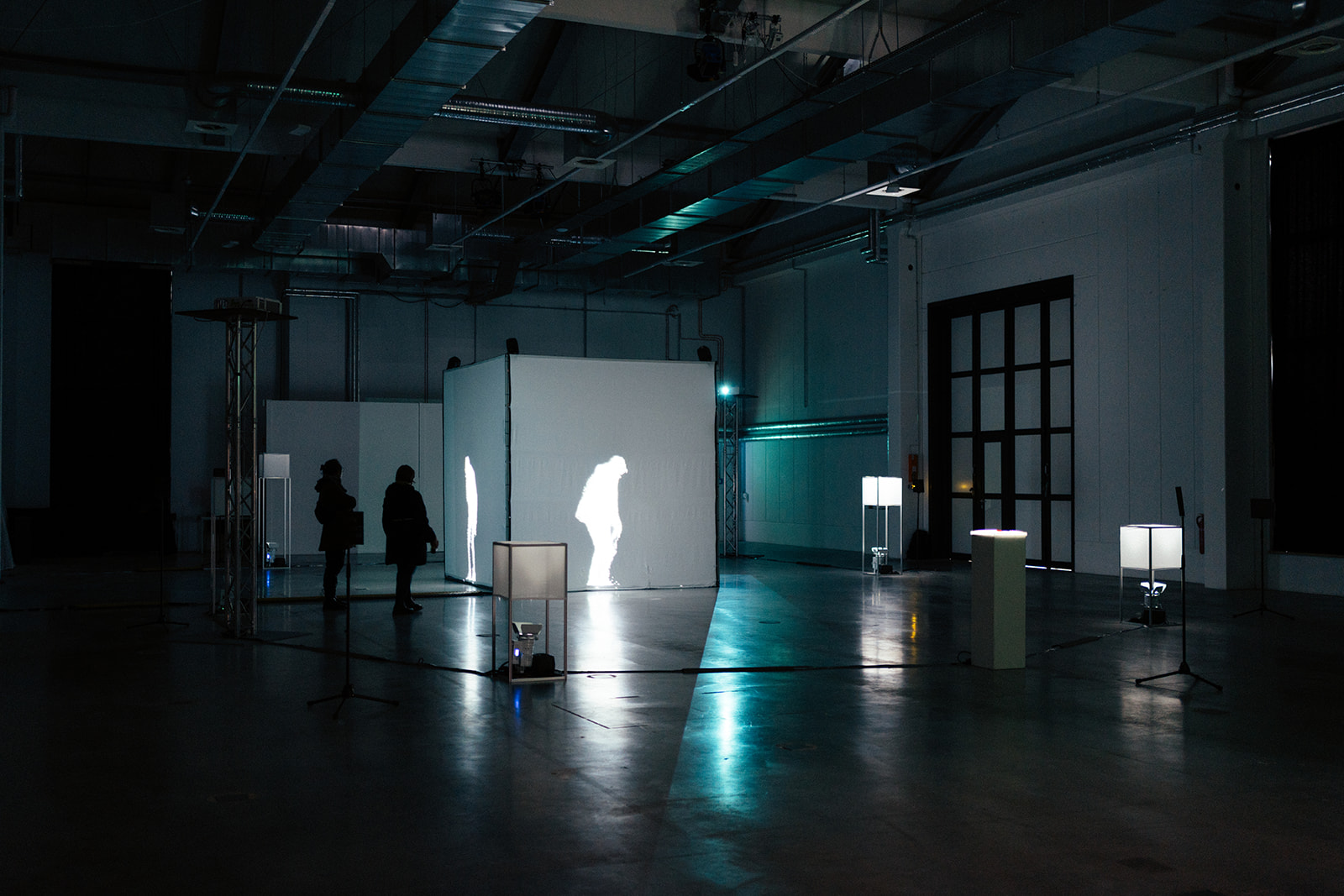
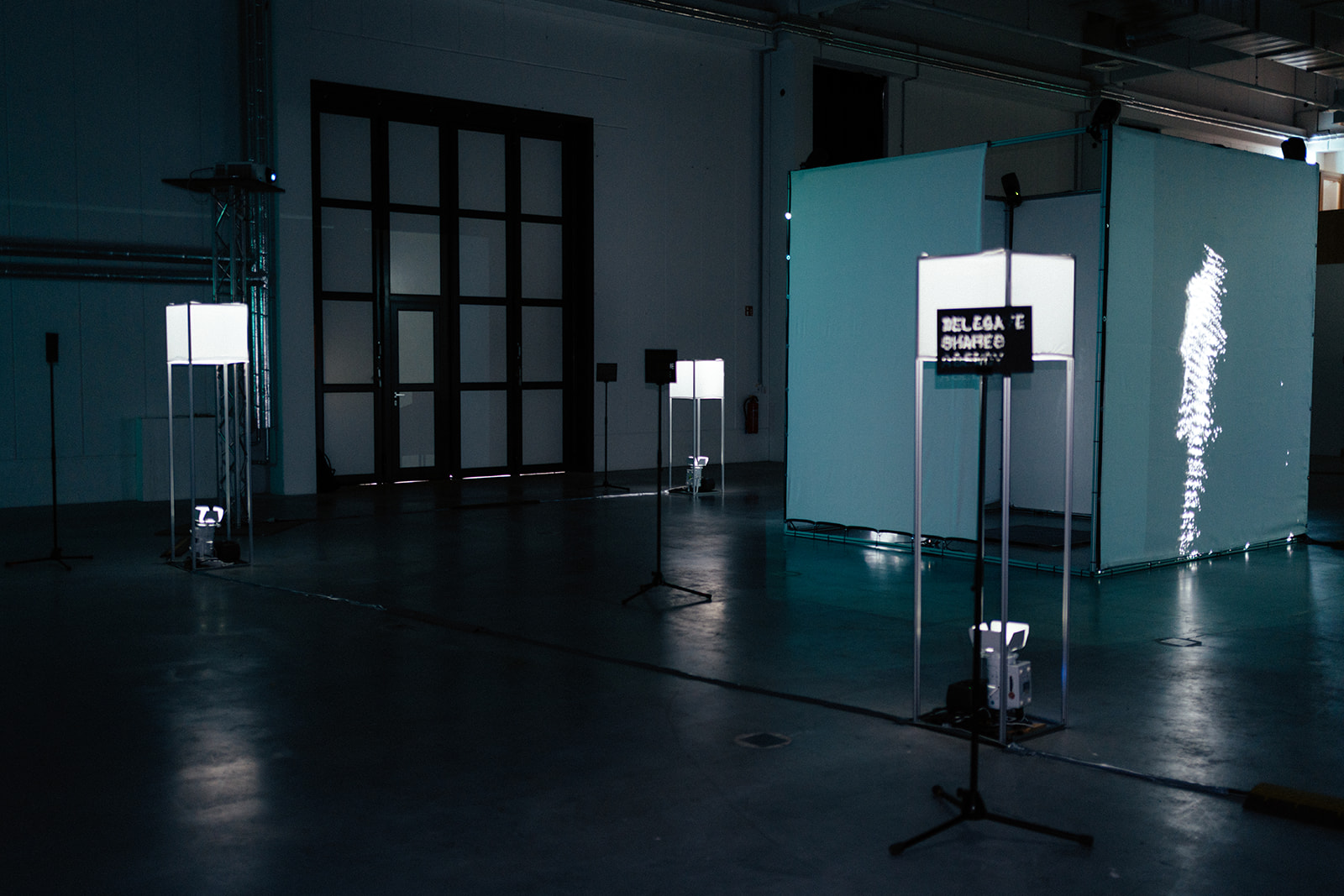
The installation is organised through connected modules:
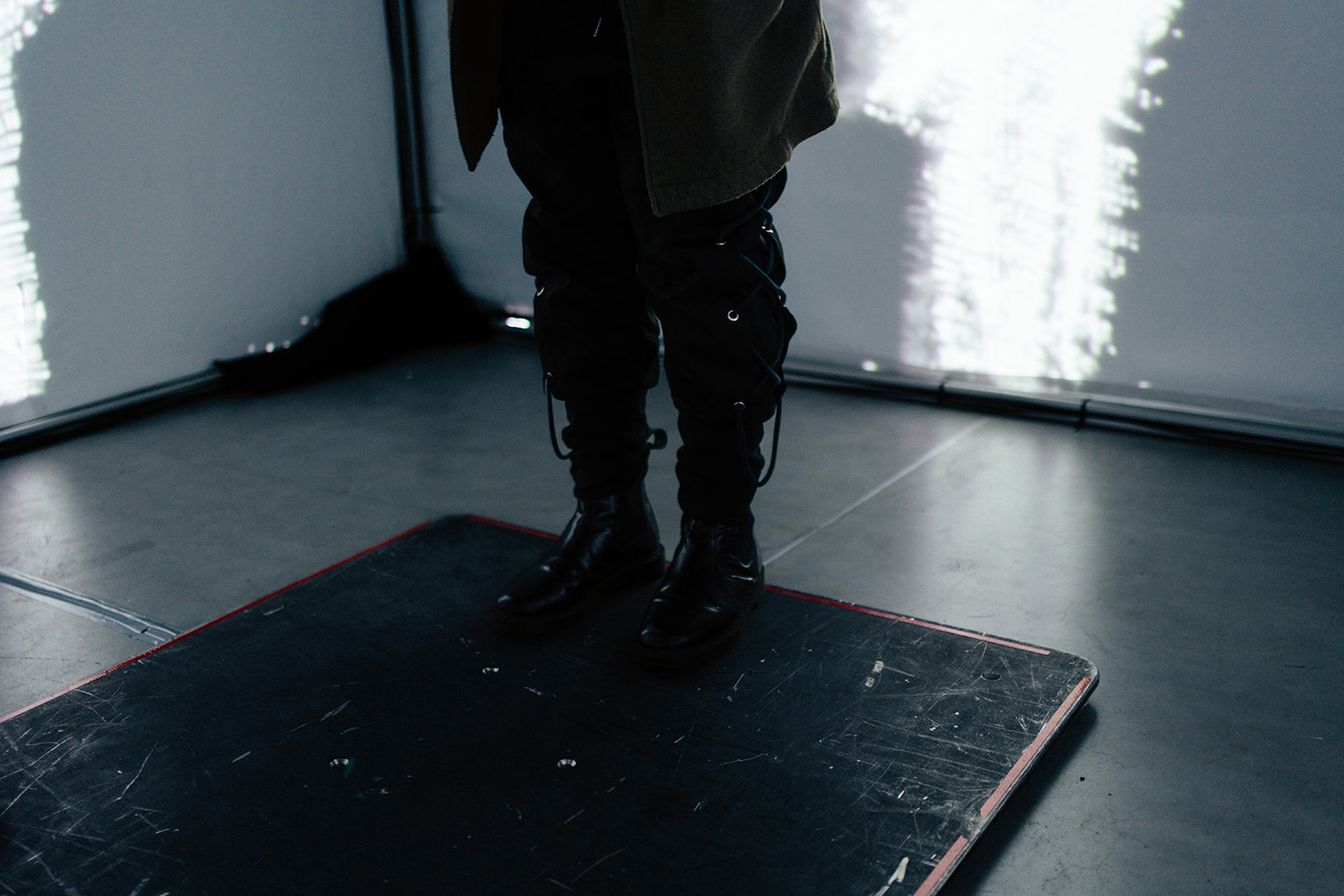
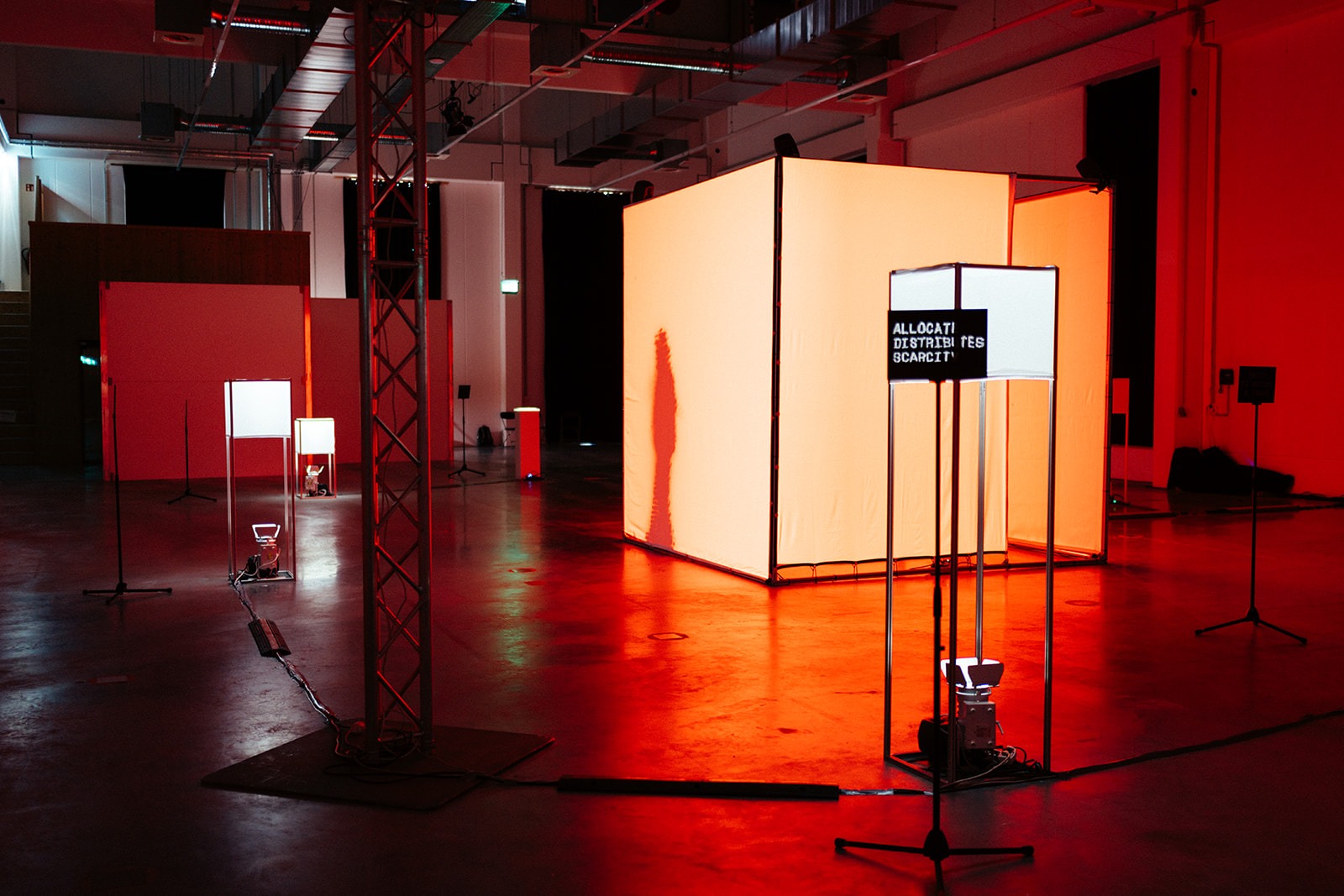
- Collection Chamber - a 3 x 3 x 3 m projection cube where visitors are captured by depth cameras and returned as live and recalled point-cloud bodies.
- Light Pillars - six distributed aluminium-and-fabric objects with speakers and DMX lights that carry recorded fragments through the room.
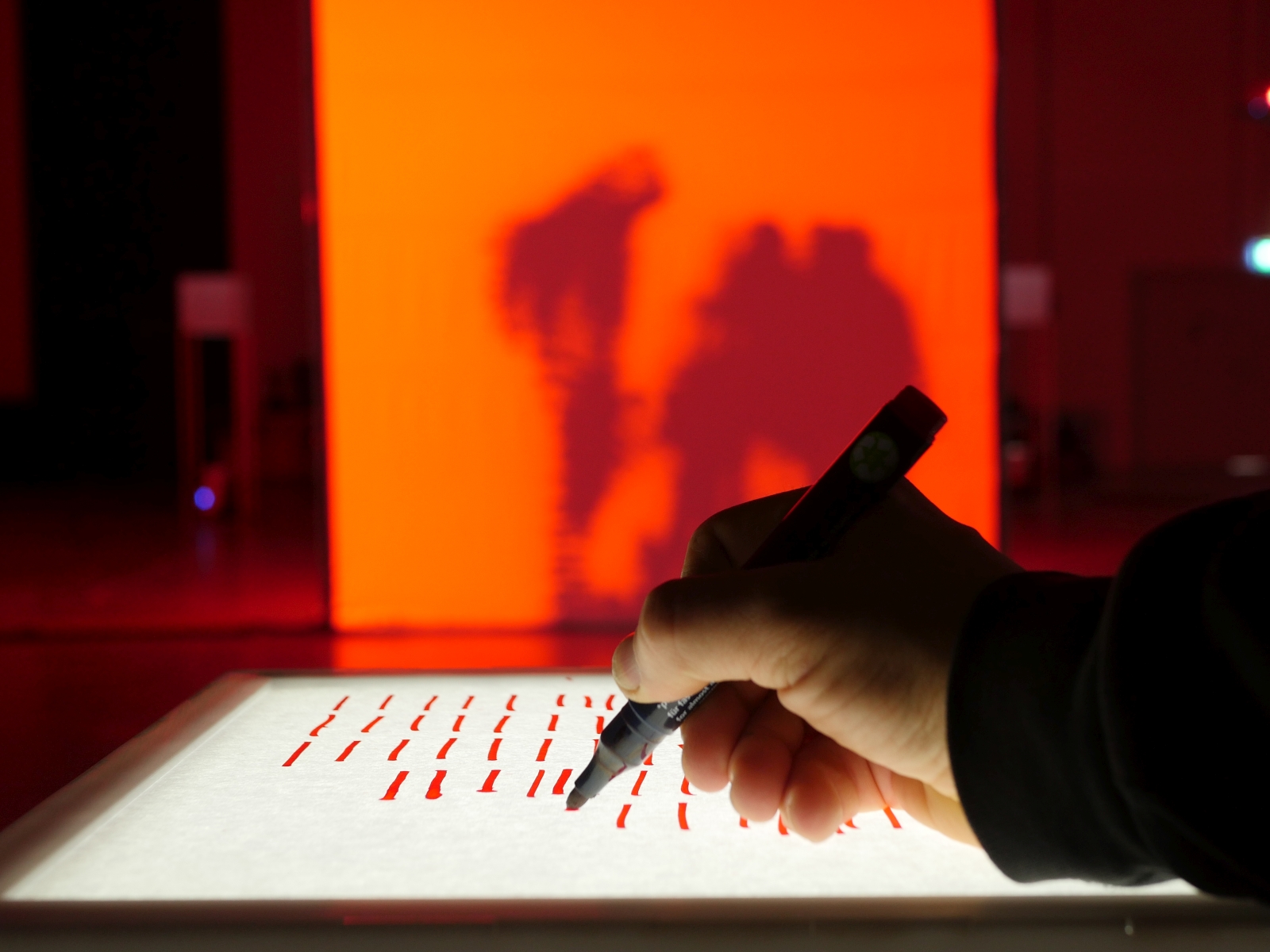
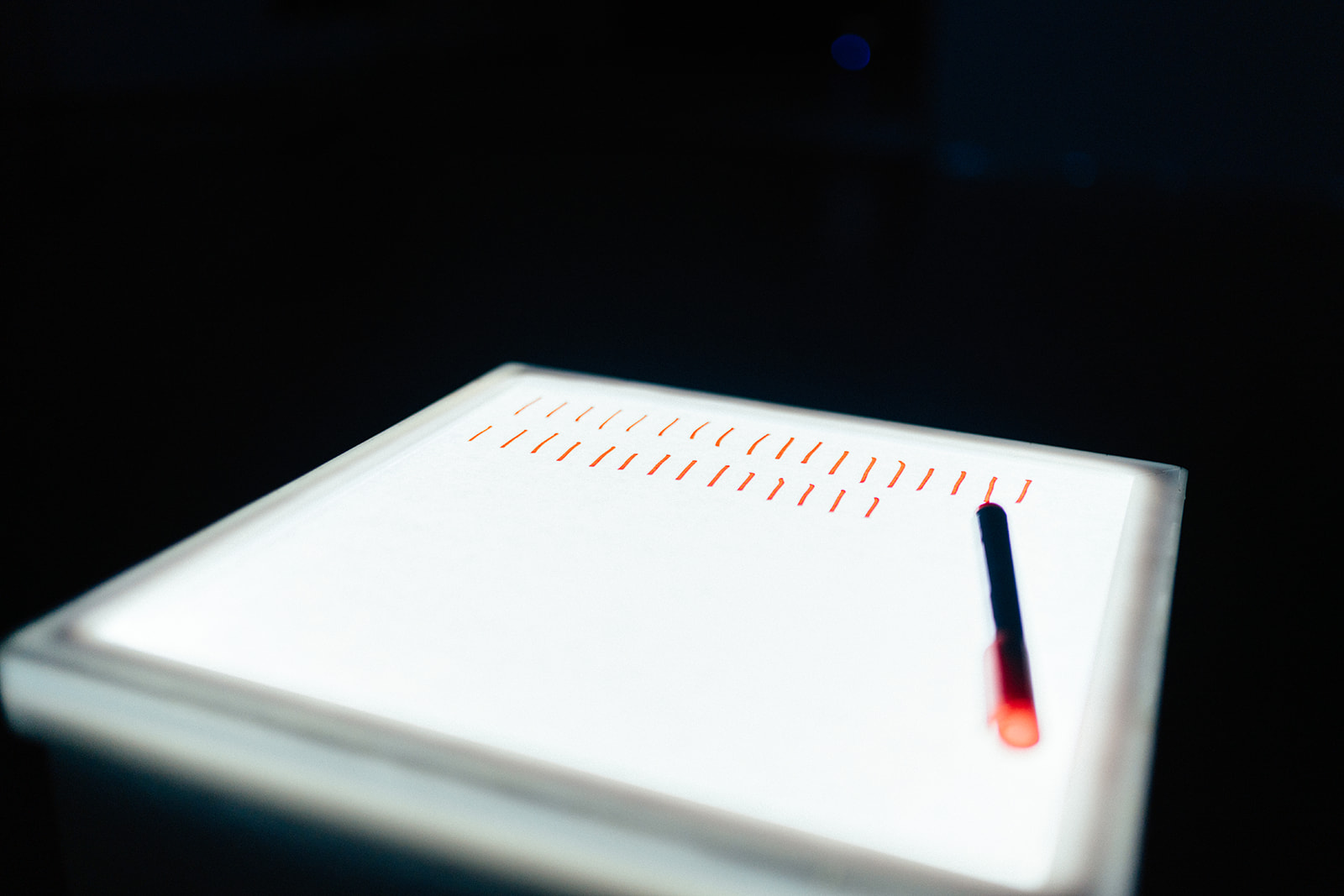
- Allocate Station - an illuminated drawing surface where a red line assigns a stored shadow to one of the available slots.
- Control system - a networked media system that manages capture, playback, state transitions, sound, light, and overload behaviour.
The system keeps running between direct interactions. Recorded shadows wander, disappear, reappear, and accumulate. Visitor actions can make the room denser: projection surfaces fill with traces, sound thickens, red light intensifies, and the system approaches overload. At the threshold it flashes, produces noise, clears slots, and returns to a quieter state.
Interaction
Inside the Collection Chamber, a visitor’s body becomes a point-cloud trace. Touching the resonating metal plate starts a short recording window of roughly fifteen seconds, linking body movement with contact sound.
At the Allocate Station, visitors draw a red mark on paper. The gesture comes from a self-tracking practice used during the production period, where each red line marked a block of occupied work time. In the installation, the mark becomes an operation: one stored shadow is sent into one slot, the selected position flashes red, and playback begins.
The room moves through five states: empty, wandering, collection, overload, and flush. These states shape the timing, density, brightness, sound pressure, and visibility of stored traces.
Research Context
The installation emerges from the afterlife of umbra: In the Digital Shadow, an audiovisual performance developed by Slava Romanov and Chi Him Chik in 2025. Parts of that production return here as material, spatial logic, and stored pressure: the cube, point-cloud bodies, projection surfaces, technical remnants, and the question of agency between human performer and computational system.
The research asks how creative production can be read through what remains after completion: files, schedules, budgets, messages, AI-assisted workflows, delegated work, fatigue, and recovery. Embodied Debrief names this return to a completed project through its residues. The installation translates that method into states of collection, allocation, overload, and release.
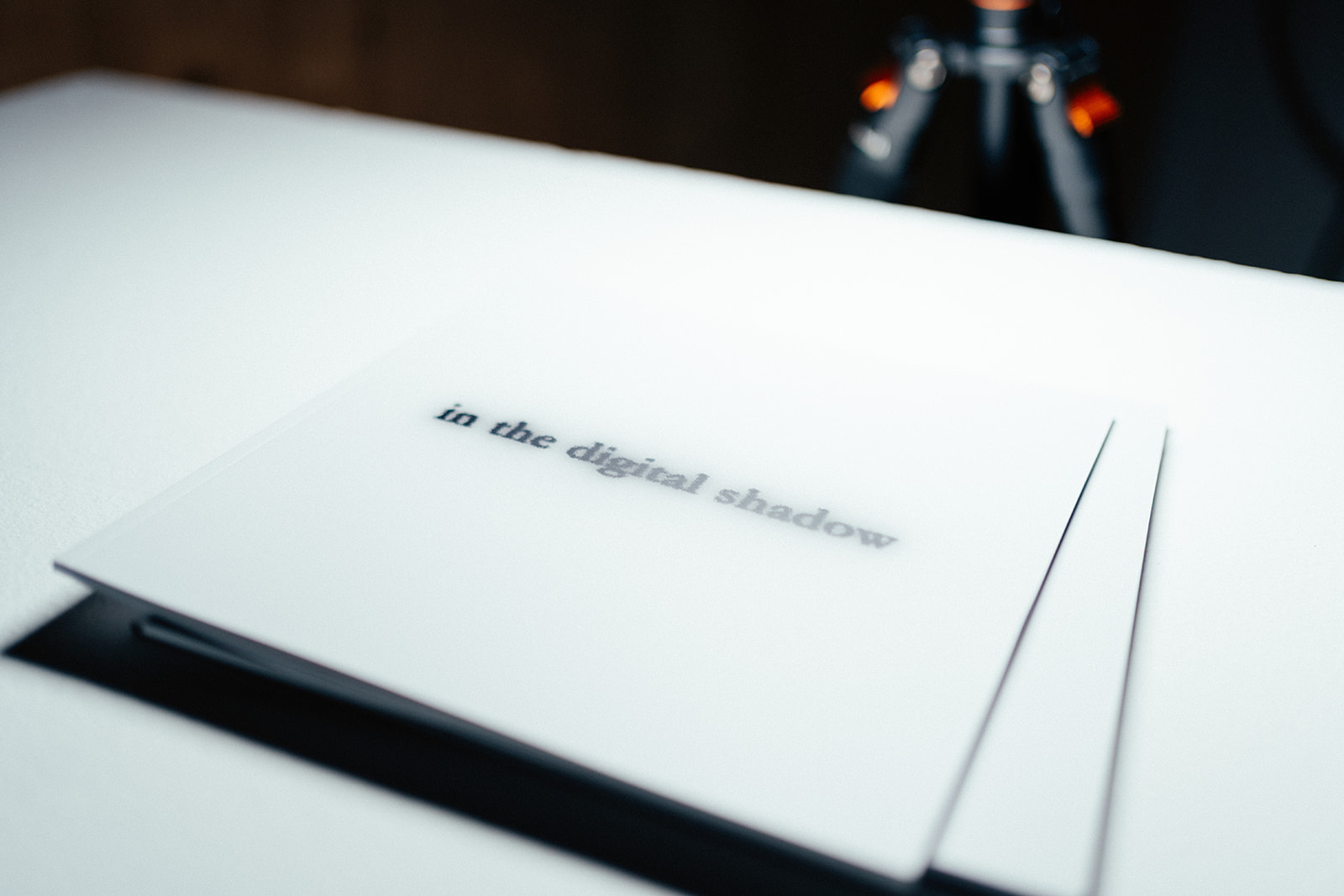
The publication in the digital shadow: An Embodied Debrief contains the extended research argument, methodology, analytical diagrams, and references. The public repository provides the thesis PDF, selected datasets, diagrams, technical notes, and extended documentation prepared for HfK Bremen.
Presentation
Presented HfK Bremen, 31 March - 2 April 2026.
Technical rider, installation requirements, and extended documentation are available on request: node@slavaromanov.art
Credits
Concept, system, installation - Slava Romanov
Related performance origin - umbra: In the Digital Shadow, by Slava Romanov and Chi Him Chik
Supervision - Dennis P. Paul, Ralf Baecker, Digital Media M.A., University of the Arts Bremen
Photography - Jimi Liu, Slava Romanov
See Also